
Maintenance · 7 min read · Updated
Why Do Radiators Bang? 7 Causes in NYC Steam Heat (and Fixes)
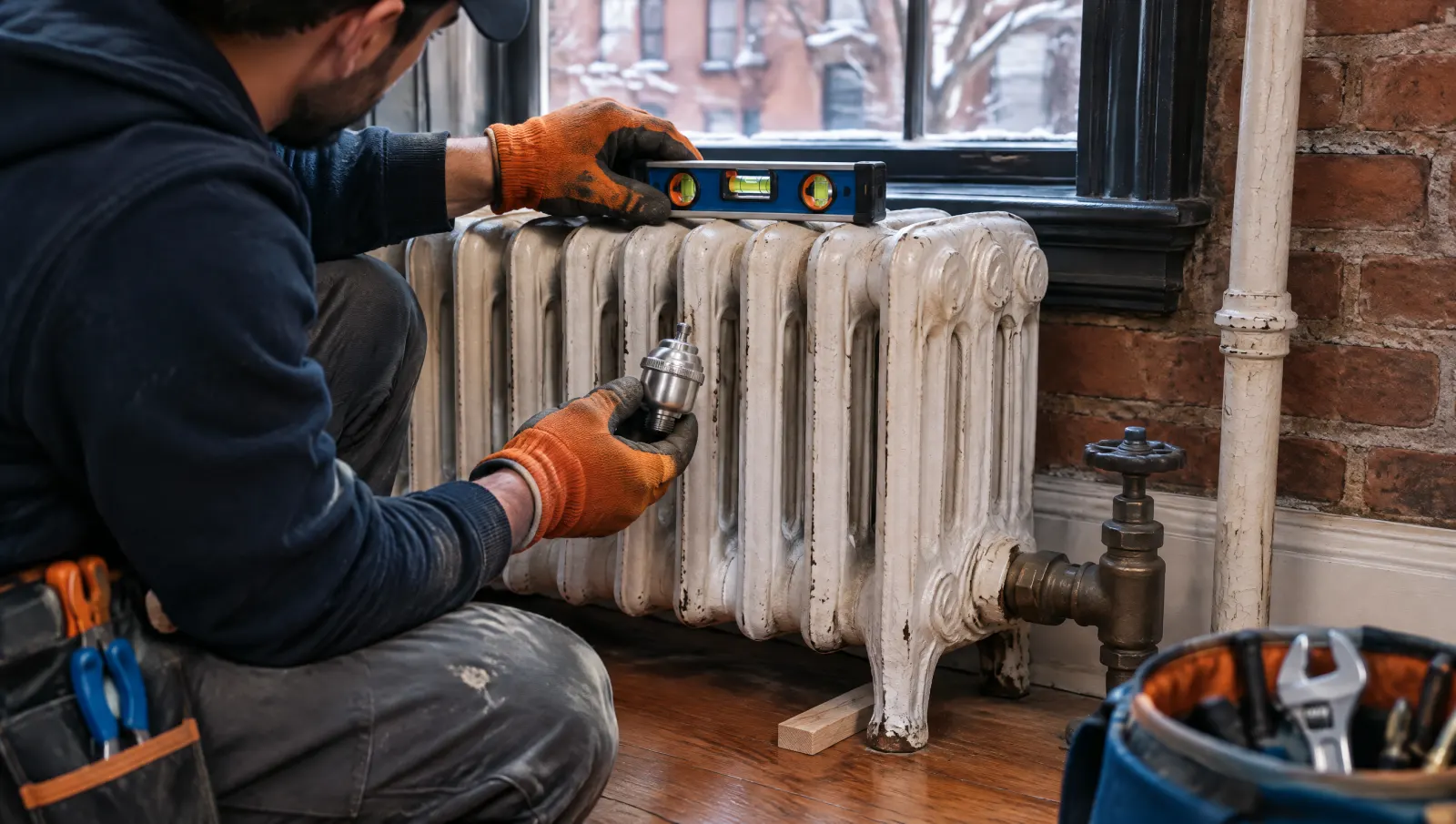
The short answer: radiators bang when steam slams into water that is trapped where it shouldn't be. That's called water hammer. In NYC steam buildings the usual reasons are a radiator tilted the wrong way, a half-closed valve, sagging pipes, too much boiler pressure or dirty boiler water. Chill Factor HVAC in Staten Island fixes these across all five boroughs, and most are not expensive.
Every November the same calls start. The heat comes up at 5am and the radiator by the window sounds like someone is hitting it with a wrench. People assume it's about to burst. It almost never is. It's loud, it's annoying, and it's telling you something is out of adjustment.
What causes a radiator to bang?
Banging is water hammer: steam moving fast through a pipe hits a pool of condensate (the water steam turns back into once it cools) and throws it against a fitting or the end of the radiator. Fix why the water is trapped and the banging stops.
A steam system is supposed to work like a loop. The boiler makes steam, the steam rises to the radiators, gives off its heat, turns back into water and drains back down to the boiler. Anything that stops that water from draining, or that pushes extra water up into the pipes, sets up the bang.
What does each radiator noise mean?
Not every sound is a problem. Some are just old iron doing its job. Here's how we sort them out on a call.
| The sound | What it usually means | Normal? |
|---|---|---|
| Loud bang or hammering, often when heat starts | Water trapped in the radiator or pipes (water hammer) | No. Needs a fix |
| Soft hiss from the small vent on the side | The air vent letting air out as steam fills the radiator | Yes, until the radiator is hot |
| Constant hiss, whistling or water spitting from the vent | A worn or stuck air vent, or water in the steam | No. Usually a vent swap |
| Ticking or pinging as it warms up | Metal pipes expanding against floors and sleeves | Yes, mostly harmless |
| Gurgling | Water sitting in the radiator or pipe that can't drain | No. Often a pitch problem |
The 7 causes of banging radiators we see most
These are the causes we find most often in brownstones, walk-ups, co-ops and older Staten Island houses with steam heat, roughly in order.
- The radiator is pitched the wrong way. On a one-pipe system (one pipe both brings steam in and lets water out), the radiator should tilt slightly back toward the valve so water can drain. Old floors settle. Once the radiator tilts away from the valve, water pools at the far end and the steam hits it. The fix is often a shim under the feet at the far end.
- The valve is half open. On a one-pipe radiator, the valve at the bottom should be all the way open or all the way closed. Half open lets steam squeeze in but blocks the water trying to get out. If you want a room cooler, the valve is the wrong tool. A thermostatic air vent is the right one.
- Pipes that sag or lost their pitch. The same rule applies to the pipes in the basement and the risers in the walls. A sagging section holds a puddle, and every cycle the steam hits it. You often hear this one in the floor or wall, not at the radiator.
- Boiler pressure set too high. Home steam heat runs on very low pressure. Dan Holohan, a long-time steam heating author, writes that most steam systems run at pressure that's much too high, and in his worked example for a one-pipe building he sets the cut-in at 1/2 psi with a 1 psi differential (Heating Help, 2020). The control that sets this is called a pressuretrol. Higher pressure means faster steam, more noise and more fuel.
- Too much water, or dirty water, in the boiler. If the water level is too high or the water is oily, the boiler throws water up into the pipes along with the steam. You may see the water in the sight glass (the glass tube on the side of the boiler) bouncing hard while it runs. Skimming and a correct water line fix it.
- A failed air vent. A vent that sticks shut slows the radiator down, and one that leaks lets water spit out. It doesn't cause the deep bang by itself, but it adds to the noise and leaves rooms uneven.
- Failed steam traps on two-pipe systems. Larger buildings often have two-pipe steam, with a separate return pipe. A steam trap is a small valve on the return side that lets water and air out but holds steam in. When traps fail, steam gets into the return lines and bangs there.
What can you safely check yourself?
A few checks are safe for anyone. Do them with the heat off and the radiator cool.
- Look at the radiator valve. On a one-pipe radiator, turn it fully open or fully closed. Nothing in between.
- Set a small level on top of the radiator. It should lean slightly toward the valve end. If it leans the other way, a thin wood or composite shim under the far feet often helps.
- Look at the air vent. If it spits water or hisses nonstop once the radiator is hot, it likely needs replacing.
- Note when the banging happens: at startup, all cycle, one radiator or the whole house. That tells a technician a lot.
Leave the boiler to a pro. That means the pressure control, the water level and the low water cutoff (the safety switch that shuts the burner off when water runs low). And don't try to bleed a steam radiator like a hot water one. It's a different system.
What if you rent or live in a co-op?
If your radiator is fed by the building's boiler, the boiler and the pipes are the building's job. Tell your super or managing agent, and say which radiator and when it bangs. You can still check that your own valve is fully open.
Noise is one thing. Not enough heat is another. From October 1 to May 31, NYC HPD requires at least 68°F inside from 6am to 10pm when it's below 55°F outside, and at least 62°F overnight. HPD says to contact your landlord first, then file a complaint through 311 (NYC HPD, 2026).
What we see on the job
The banging radiator is rarely the radiator's fault. Most of the time we fix it with a level, a shim, a new vent or a boiler pressure setting that someone cranked up years ago to "get more heat." It doesn't get you more heat. It gets you more noise and a higher fuel bill.
When the whole house bangs, we look at the boiler first: water line, water quality, pressure and the near-boiler piping. When one radiator bangs, we start at that radiator. Our heating service covers steam and hot water boilers. A diagnostic visit runs $150 to $250 and a heating tune-up $220 to $400. Those are ranges, and you see your price before we start. See the full list on our pricing page.
If the noise came with no heat at all, start with our no-heat checklist, and call our emergency line if you smell gas or a CO alarm goes off.
The quick version
Banging means trapped water. Check that the valve is fully open or fully closed and that the radiator tilts toward it. If the whole system bangs, the boiler pressure or water is the likely cause, and that's a job for Chill Factor HVAC, not a weekend project. Fixed right, a steam system should be close to quiet.
Frequently asked questions
Why do my radiators bang only when the heat first comes on?
Startup banging usually means water sat in a radiator or pipe overnight and the first rush of steam hits it. A radiator tilted away from its valve, a half-open valve or a sagging pipe are the common reasons. If it settles down after a few minutes, it's still worth fixing, because the same trapped water slows your heat every cycle.
Should a steam radiator valve be fully open or partly closed?
On a one-pipe steam radiator, the valve should be all the way open or all the way closed. A half-open valve lets steam in but blocks the water from draining back, which causes banging and spitting. To make a room cooler, use a thermostatic air vent instead of the valve.
Is a banging radiator dangerous?
Banging on its own is usually a sign of trapped water, not a sign the radiator is about to burst. Repeated hard water hammer can loosen fittings and wear out vents over time, so it's worth fixing. A smell of gas, a carbon monoxide alarm or water pouring from a pipe is different: leave and call 911 or a technician right away.
Why is my hot water radiator or baseboard banging?
Hot water systems bang for different reasons than steam. Air trapped in the lines, a circulator problem or a boiler that is kettling (scale making water flash to steam inside the boiler) are the usual causes. Bleeding the radiators may help with air, but kettling and pressure problems need a technician.
Who fixes a banging radiator in a NYC rental or co-op?
If the radiator is fed by the building's boiler, the boiler and piping are the building's responsibility, so tell your super or managing agent which radiator bangs and when. You can safely check that your own valve is fully open. For a house or a boiler you own, a heating technician can check pitch, vents, pressure and water level.
How much does it cost to fix a banging radiator in NYC?
With Chill Factor HVAC, a diagnostic visit is $150 to $250 and a heating tune-up is $220 to $400. These are ranges because buildings and systems differ, and you get a flat quote before any repair starts. Many banging problems turn out to be a shim, a new air vent or a pressure adjustment.